Why You're Overreacting (And It Has Nothing to Do With Right Now)

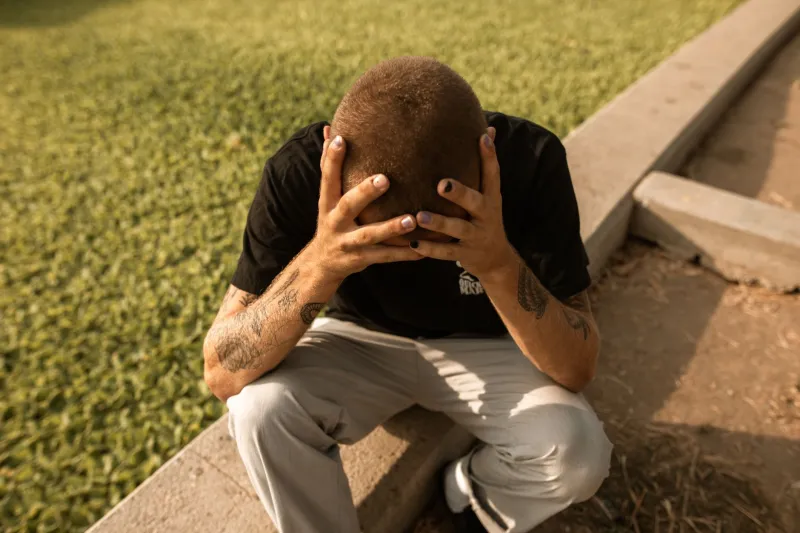
Photo by Photo by Austin Schultz on Unsplash on Unsplash
Your partner forgets to text you back for a few hours and suddenly your chest is tight, your mind is spinning worst-case scenarios, and you're already rehearsing an argument in your head. Or your boss gives you a piece of critical feedback in a meeting and you feel a hot wave of shame so intense you can barely focus for the rest of the day.
Later — maybe hours later, maybe days later — you look back and think: Why did I react like that? That was so out of proportion.
You're right. It was out of proportion. But here's the thing: you weren't actually reacting to what happened. You were reacting to something much older.
What an Emotional Flashback Actually Is
Most people associate the word "flashback" with dramatic cinematic sequences — vivid visual memories, soldiers, PTSD. But emotional flashbacks are far more common, far more subtle, and far more disruptive to everyday life than most people realize.
An emotional flashback isn't necessarily a visual memory. It's a sudden, intense reliving of the feeling state from a past experience — often from childhood or a previous painful relationship — triggered by something in the present that your nervous system has tagged as similar. You might not remember anything specific. You just feel it: the panic, the shame, the helplessness, the rage. And it feels completely, urgently real.
Psychotherapist Pete Walker, who has written extensively about complex trauma, describes emotional flashbacks as sudden regressions into the overwhelming feelings of past abandonment, rejection, or danger. The tricky part? They don't announce themselves. Your brain doesn't say, "Hey, this is actually about something that happened twenty years ago." It just floods you with the emotion and tells you it's about right now.
The EQ Gap This Creates
Emotional intelligence — specifically self-awareness and emotional regulation — depends on your ability to accurately identify what you're feeling and why. Emotional flashbacks blow a hole right through that process.
When you're in the grip of one, your emotional response is being authored by the past, but your conscious mind is trying to make sense of it in the present. So you build a case. You find evidence that your partner is pulling away. You convince yourself your boss really does have it out for you. You're not lying — you genuinely believe the story your brain is constructing. But the story is being built on a foundation that has nothing to do with current reality.
This is one of the core reasons people get stuck in patterns — the same arguments, the same relationship dynamics, the same self-sabotaging responses — no matter how much they want to change. Until you can recognize an emotional flashback for what it is, you can't interrupt it.
How to Tell the Difference: Past vs. Present
So how do you know when you're in a flashback versus responding to something genuinely threatening or worth being upset about? Here are some practical markers:
Intensity out of proportion to the trigger. If your emotional reaction is a 9 out of 10 and the actual situation is maybe a 3, that gap is a signal. Real current threats produce proportionate responses. Flashbacks produce flooding.
A sudden sense of helplessness or smallness. This is particularly telling. If a current conflict suddenly makes you feel young, powerless, or trapped — like there's no way out — that's often the emotional signature of an old wound.
Rigid, all-or-nothing thinking. In a flashback, nuance disappears. Everything becomes catastrophic or binary. "They never care about me." "I always mess things up." "This always happens." Watch for the always/never language.
Physical cues before emotional awareness. Your body often knows before your mind does. Tight throat, shallow breathing, a sinking stomach, or a sudden urge to disappear or fight — these can be early indicators that your nervous system has been triggered into a past state.
Building the Pause: A Practical Framework
Recognizing an emotional flashback doesn't make it stop immediately. But it creates something invaluable: a sliver of space between the trigger and your response. That space is where emotional intelligence lives.
Here's a simple framework to work with:
Name it to tame it. When you notice the disproportionate intensity, say to yourself (or out loud if you're alone): "This feels like a flashback. Something old got activated." Naming the experience begins to shift you from the reactive part of your brain back toward the thinking part.
Ground yourself in the present. Use your senses. Name five things you can see. Feel your feet on the floor. The goal is to anchor your nervous system in now — not because the past isn't real, but because right now, in this moment, you're safe.
Delay the response. You don't have to resolve the current situation while you're flooded. "I need a few minutes before I respond to this" is not avoidance — it's high-EQ behavior. Decisions and conversations made in a flashback state almost always make things worse.
Trace the feeling backward. When you're calmer, ask: When have I felt exactly this way before? Let your mind wander. The answer often surfaces surprisingly quickly, and it's almost always older than the current situation.
Rewiring Over Time
This isn't a one-time fix. Emotional flashbacks are patterns wired by repetition, and they're unwired the same way — through consistent, patient practice of noticing, naming, and choosing differently.
Over time, as you build the habit of catching yourself mid-flashback, something shifts. The gap between trigger and response gets wider. You start to hold two truths at once: I feel something real, and this feeling might not be entirely about right now. That dual awareness is the hallmark of genuine emotional intelligence — and it's genuinely transformative.
Your past shaped you. It doesn't have to run you.